
Q: When it comes to recalculate of bathy data what types of calculations and formulas does NaviEdit have and use?
A: NaviEdit supports multiple types of pressure to depth conversion formulas.
The dialog can be accessed from the Header Editor, the Data Editor, the Batch Process and the Multibeam Importer. There are only small differences between the options available when accessing from these different locations.
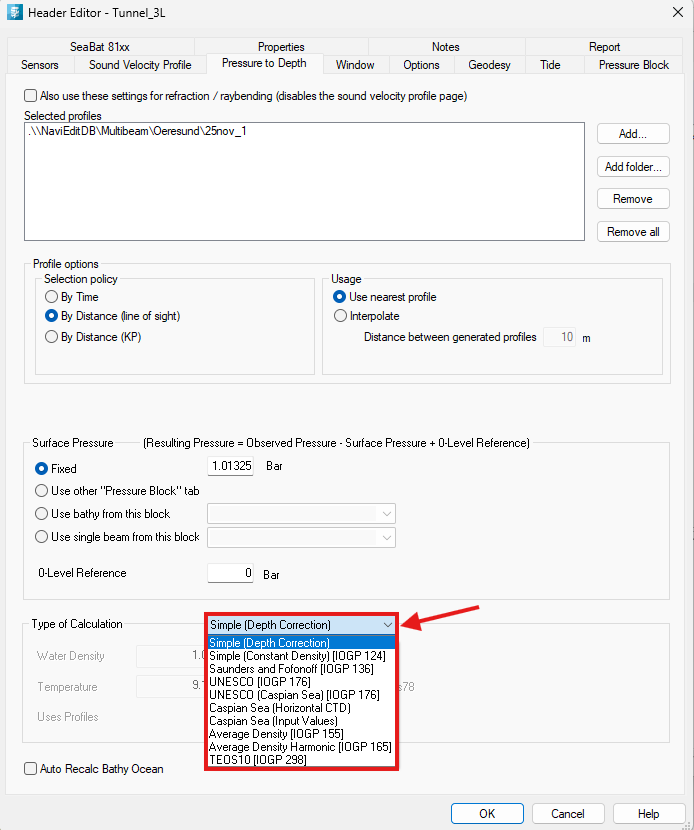
Figure 1. Header Editor Pressure to Depth tab
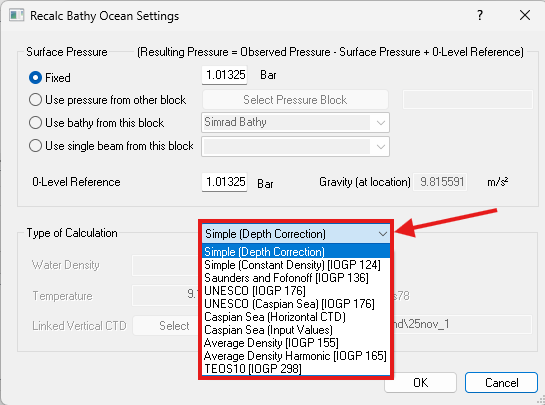
Figure 2. Recalc Bathy Ocean Settings from the Batch Process window
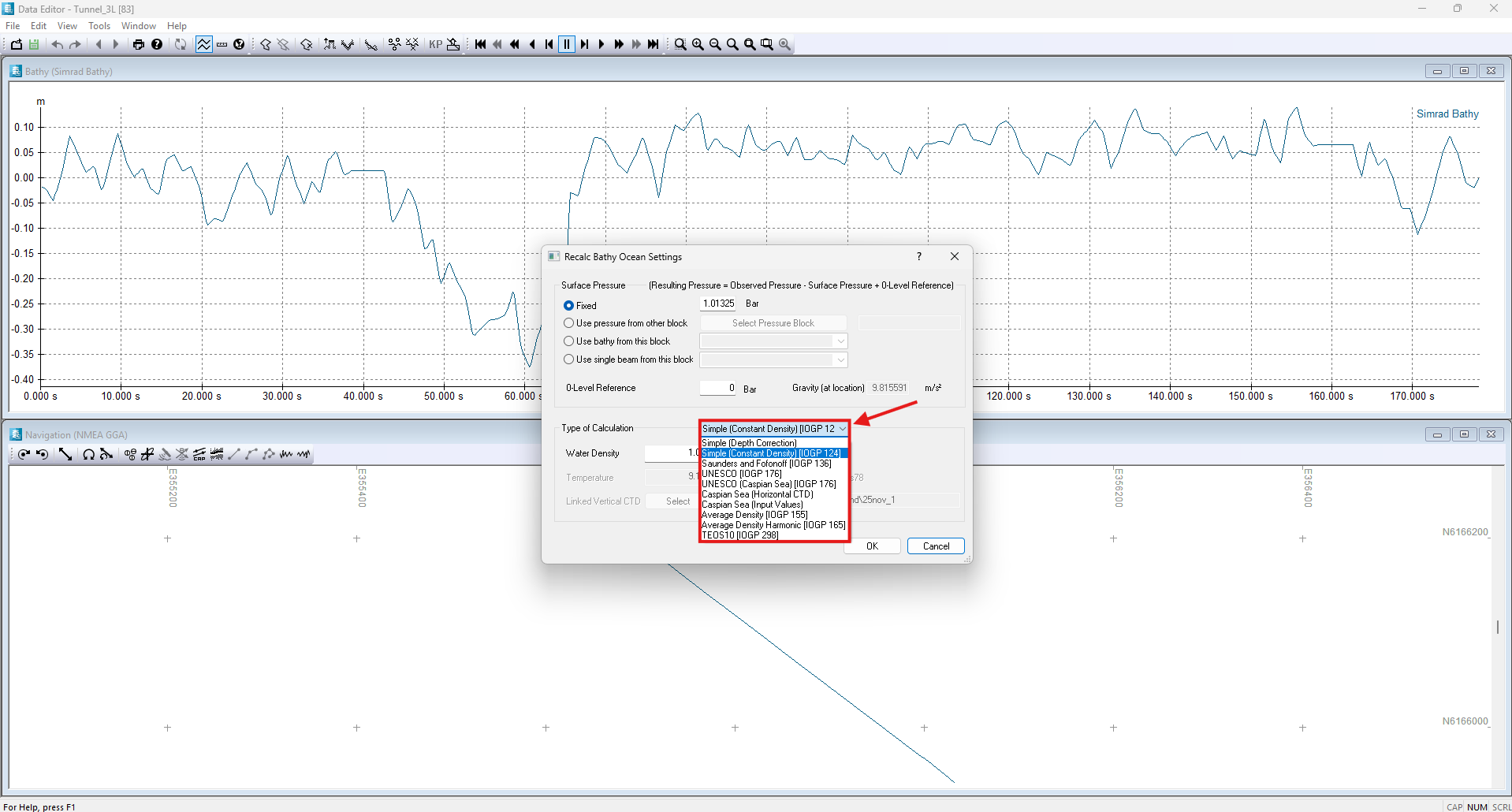
Figure 3. Recalc Bathy Ocean Settings from Data Editor Bathy view
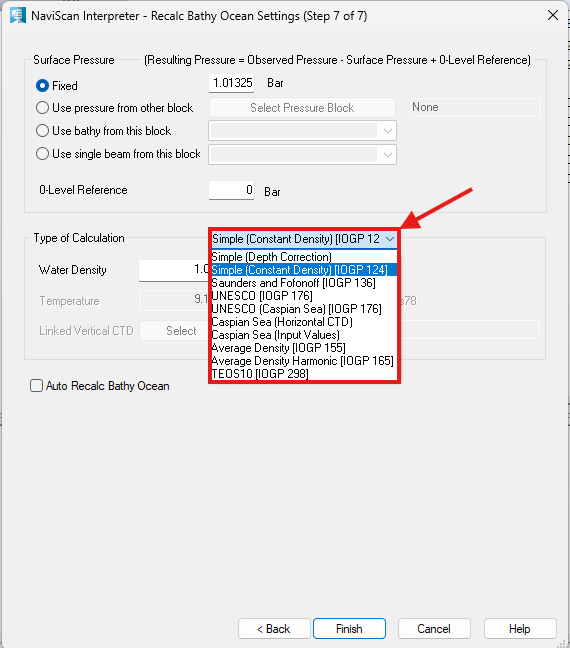 Figure 4. Recalc Bathy Ocean Settings from Multibeam Interpreter
Relevant for all methods, except for the Simple (Depth Correction), the underwater sensor pressure data is preprocessed/tare using the chosen surface pressure (fixed, or time series) and the 0-reference level, according to the formula shown also in the GUI: “Resulting Pressure = Observed Pressure – Surface Pressure + 0-Level Reference“
Principles of the seawater pressure to depth conversion
The calculation takes as input pressure data points assumed to be measured by a sensor underwater, and outputs an estimation of the corresponding seawater column heights (or seawater depths). The depth is considered from the instantaneous seawater surface level. Additional transformations and offsets (related to for example other reference surfaces such as geoid, etc. or offsetting the tide levels) are not discussed here but can be performed from other dialogs.
Additionally, information or approximations about the atmospheric (water surface) pressure is needed. Either a fixed surface pressure or a time-series of surface pressure data (from different sources) can be used here. There is also the possibility of specifying an additive constant instrument correction/calibration term (0-reference level).
Furthermore, to obtain a more precise result, the calculation can make use of a CTD profile. A CTD profile is a vectorized measurement containing rows of pressure, temperature, and conductivity (and other properties) data points. The idea is to have information about relevant water column properties at/close to location and in time (from temperature and conductivity, practical salinity can be estimated, and thus also the seawater density at different pressure bins).
Using the framework and terminology from (Seawater pressure to depth conversions, 2023), a conversion method consists of two main elements:
- A geopotential model (or dynamic height
 ), which aims to summarize the main properties of the seawater column. It is generally defined as the integral of the seawater specific volume over the pressure range starting from 0 (instantaneous sea water surface) down to the bottom/measurement data point.
 - A model for the gravitational acceleration,

The depth/height result of the calculation method (distance/meters) is the ratio of the geopotential terms and the gravitational acceleration term, that is 
Some specifics of the seawater pressure to depth conversion
Geopotential models
- A simple approximation of the geopotential is the “standard ocean dynamic depth”, a polynomial formula that takes pressure as input and its result approximates the integral of the specific volume for the seawater at salinity 35 PSU and temperature 0 degrees Celsius:

- The difference between the “true” geopotential and the standard ocean dynamic depth is called the “dynamic anomaly” or “geopotential anomaly”:

Gravity models
- A standard way to compute the gravitational acceleration on the surface of the earth is a polynomial that is latitude dependent:

- For more precision, the depth can be taken under account in the gravitational acceleration model, in the form of an additive correction term. Since depth is not yet known normally, it can be approximated with the processed pressure measurement:

For more details, the (Seawater pressure to depth conversions, 2023) can also be consulted.
First formula, simple (depth correction):
This method does not use the pressure input data, but the (already existing, current) seawater height/depth as associated with the pressure data in the database. Thus, the current depth value is reused.
It creates a correction term by adding the (new, specified) reference 0-level pressure term and subtracting the (new, specified) surface pressure term (both in Bar) and multiplying by 10 to obtain a distance. This thus makes use of the working assumption of 1 decibar approximately equals 1 meter.
This method is adding to the existing depth, the result of calling the method several times will not give the same output.
Second formula, simple (constant density, IOGP 124):
This method corresponds to code 124, according to the convention from (Seawater pressure to depth conversions, 2023) .
The geopotential/dynamic height model for the water column uses a constant seawater density assumption (with value provided by user), and thus a constant specific volume. A typical range for water density constant is 1.020 to 1.029 [kg/dm3], but the user is free to choose any value. Thus the geopotential is the inverse of specified density multiplied with the pressure. This method uses the polynomial gravity model without the depth correction term.
Third formula, Saunders and Fofonoff (IOGP 136):
This method corresponds to code 136 according to the convention from (Seawater pressure to depth conversions, 2023) . The geopotential/dynamic height model for the water column uses the EOS-80 seawater thermodynamic formulas under a standard ocean (temperature 0 Celsius and practical salinity 35) assumption. Furthermore, In this calculation, the integral is approximated by a quadratic polynomial approximation in terms of the (bottom) pressure. This method uses the polynomial gravity model with the depth correction term, where the constant 
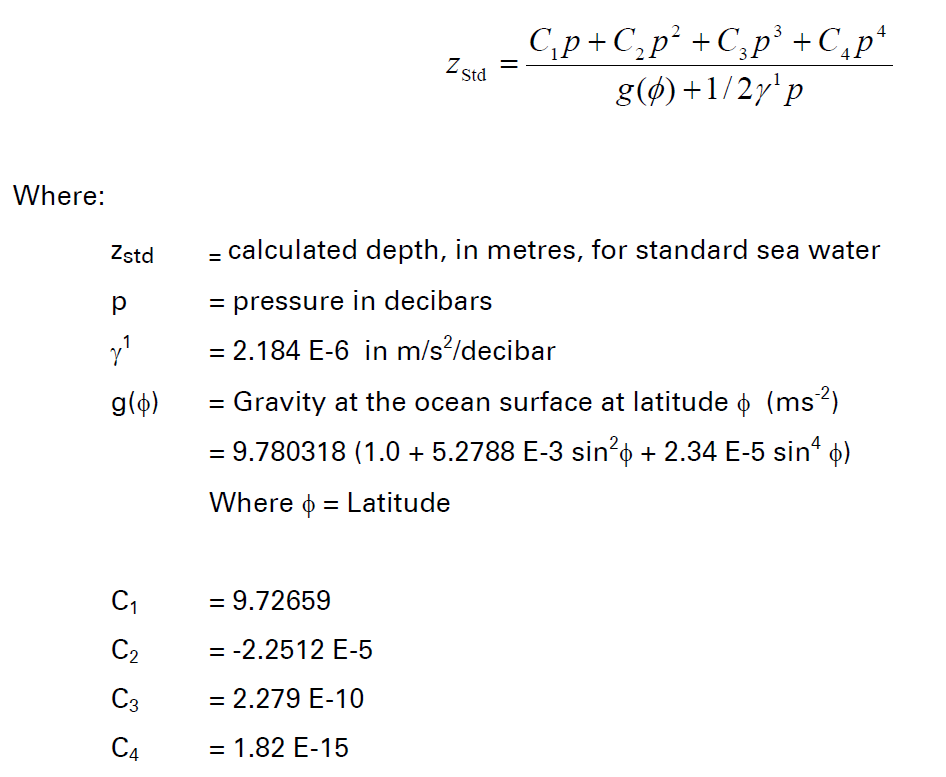
Forth formula, UNESCO (IOGP 176):
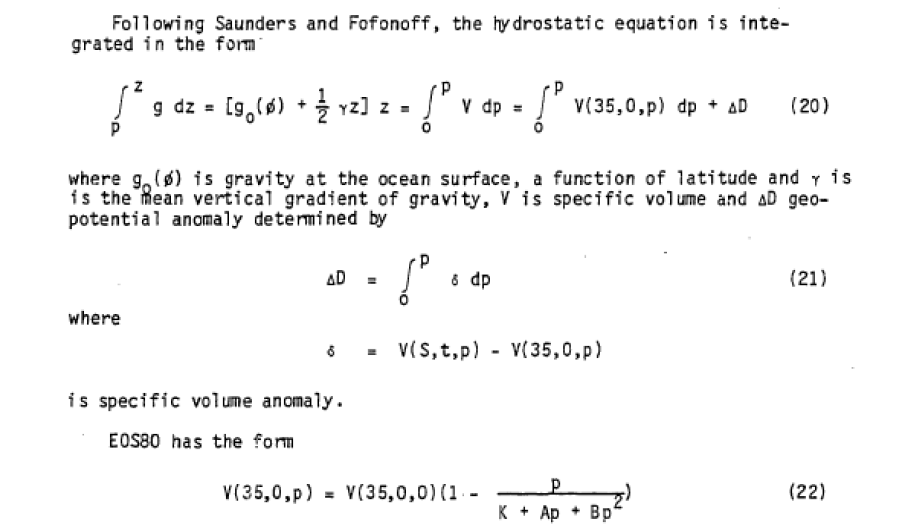
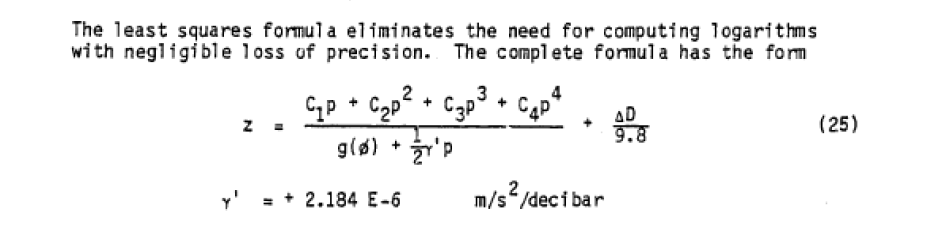
This method corresponds to equation (25) from (Fofonoff, 1983) and to code 176 according to the convention from (Seawater pressure to depth conversions, 2023).
The geopotential/dynamic height model integrates the specific volume with respect to the water column pressure up to the sensor data point, where the specific volume is approximated from available EOS-80 seawater thermodynamic formulas from practical salinity, temperature and pressure. The integration requires availability of thermodynamic properties along the water column, which are taken from the required/associated CTD profile data (and extensions of this data). Furthermore, the specific volume integration uses the standard ocean polynomial with a dynamic anomaly additive term. It is the dynamic anomaly term that contains the integral and the CTD specific information. An interesting aspect here is that while the standard dynamic depth is scaled by the fully gravitational model (with correction term), the dynamic anomaly is scaled by the 9.8 constant.
Fifth formula, Caspian Sea - requires a linked CTD (IOGP 176):
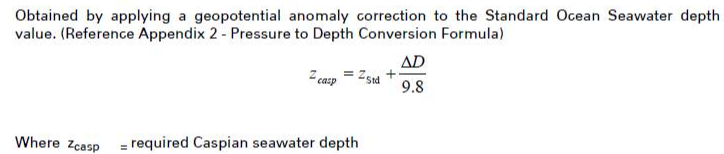
The difference between this method and the UNESCO method above is the calculation of the specific volume from practical salinity and temperature by a variant of the thermodynamic equations/approximations which is more suitable for the Caspian Sea. The difference is thus in the dynamic anomaly term. Even more precisely, the difference stems from a variant of the formula for the calculation of density from salinity and temperature for the Caspian Sea waters from (Millero, et al., 2008).
Sixth formula, Caspian Sea (Horizontal CTD / Auxiliary Sensor) - requires a horizontal CT (Aux Sensor):
This method calculates the seawater height/depth based on the sensor pressure data and CTD data from a horizontal sensor (not a CTD profile, but similar data content of conductivity and temperature). A difference is that the time and location scale are perfectly matching with the pressure sensor data.
The geopotential/dynamic height model uses the standard ocean polynomial approximation, which is then scaled by the ratio between the EOS-80 standard (35 PSU, 0 C) ocean seawater density and the EOS-80 Caspian Density variant at the current salinity and temperature from the auxiliary horizontal sensor data;
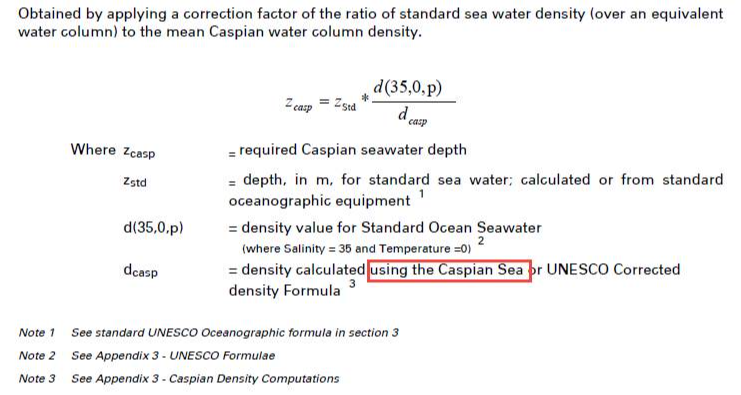
The Caspian Sea formula is:
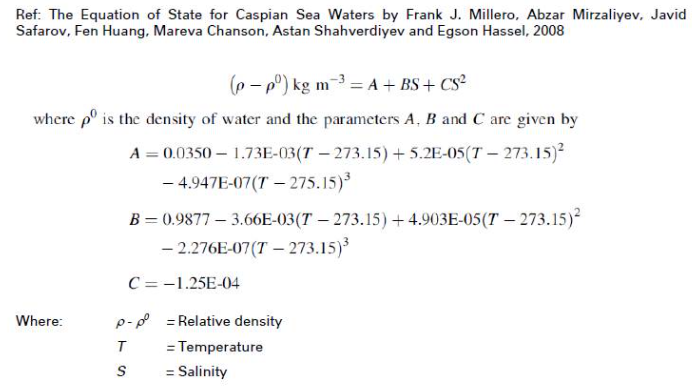
Seventh formula, Caspian Sea - input values:
This method is similar with Caspian Sea (Horizontal CTD) in terms of the dynamic height model calculation. The difference is that two user constants are used for temperature and salinity, and the of density is obtained again by the Caspian Sea waters formula from (Millero, et al., 2008).
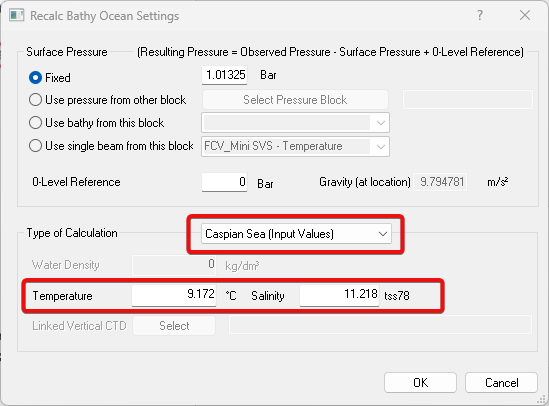
Eighth formula, Average Density (IOGP 155)
This method corresponds to code 155 according to the convention from (Seawater pressure to depth conversions, 2023).
The geopotential/dynamic height model uses the average of the water column density up to the current pressure point, and the specific volume as the inverse of this average density. The CTD data is always equidistantly binned by NaviEdit as a preprocessing step, and as such that the average calculations is not distorted. The gravity model is based on the latitude polynomial and also contains the additive correction term with  .
.
Ninth formula, Average Density Harmonic variant (IOGP 165)
This method corresponds to code 165 according to the convention from (Seawater pressure to depth conversions, 2023).
This method uses a CTD profile data. The geopotential/dynamic height model uses the harmonic average of the water column density up to the current pressure point, and the specific volume is computed from the harmonic average density. The gravity model is based on the latitude polynomial and also contains the additive correction term with  .
.
Tenth formula, TEOS-10 (IOGP 298)
This method corresponds to the code 298 according to the convention from (Seawater pressure to depth conversions, 2023)
The geopotential/dynamic height model uses CTD information processed into absolute salinity and conservative temperature values as basis for the dynamic anomaly calculation.
Additional notes for TEOS-10
- The TEOS-10 recommendation is to perform pressure to depth calculations with a uniform assumption of the surface pressure equal to 1.01325 Bar. NaviEdit does not enforce this recommendation, and the user is free to choose other options for the surface pressure, including setting a Fixed pressure of the recommended value
- Temperature scale transformation are not performed on the sensor collected data with respect to differentiating between IPTS-68 and ITS-90 temperature scales. The multiplicative scale factor for adjusting ITS-90 values to IPTS-68 values for the ranges relevant for seawater characterization is 1.00024. A NaviEdit user can choose to process the temperature data as an extra step for conversion to IPTS-68 before performing a EOS-80 pressure to depth calculation (all except TEOS10).
Surface Pressure
Formula used:
Resulting Pressure = Observed pressure - Surface Pressure + 0 (Level Reference Pressure)
The options that can be used:
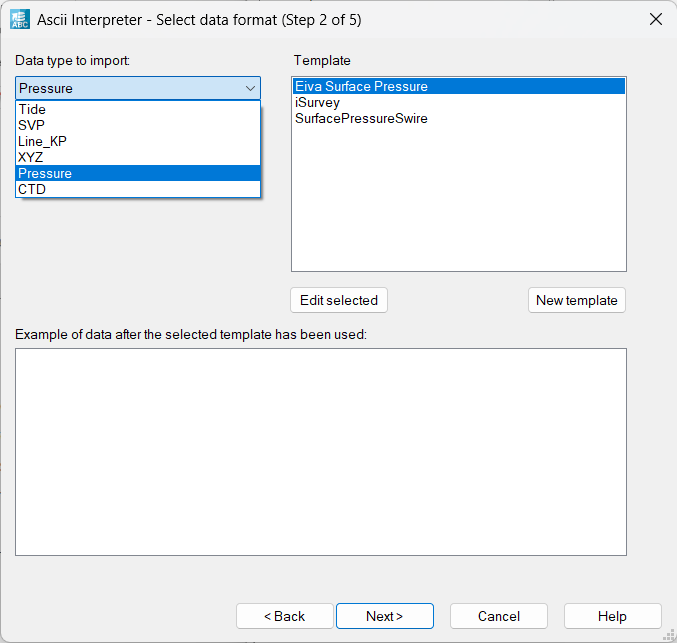
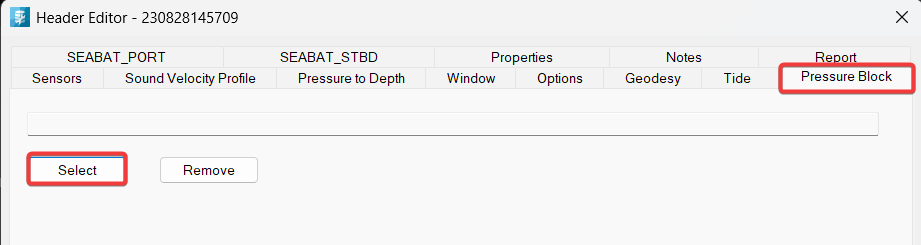
3. Use single beam for this block: allows to select another instrument where the surface pressure was logged. For pressure sensor types, NaviEdit will in some cases import the pressure as a bathy and in other cases as a single-beam/channel. You can choose to either use a bathy or single-beam/channel.
4. 0-Level Reference - this is for tare and needs to be entered in bars. It can be used when the tare was not set/subtracted from the instrument.
References
Fofonoff, N. P. (1983). Algorithms for computation of fundamental properties of seawater. UNESCO technical Papers in Marine Science.
Millero, F. J., Mirzaliyev, A., Safarov, J., Huang, F., Chanson, M., Shahverdiyev, A., & Hassel, E. (2008). The Equation of State for Caspian Sea Waters. Aquatic Geochemistry, 14(4), 289-299.
(2023). Seawater pressure to depth conversions. International Association of Oil & Gas Producers.